Aviation Safety
Lithium Battery Fires on Aircraft: Protecting Crew and Passengers with Brimstone Preventer™ Bags
Lithium-ion batteries are an integral part of modern aviation. They power mobile phones, tablets, laptops, portable medical devices and other electronic equipment routinely used by passengers and crew on board aircraft. Although these devices are practical and powerful, their batteries can pose a safety risk if damaged, defective or overheated.
One of the most serious scenarios is known as thermal runaway. This process can cause a rapid increase in temperature, flames, the release of hot gases and dense smoke. In the confined environment of an aircraft cabin, smoke and potentially hazardous combustion by-products can significantly complicate the management of an emergency.
Specialised equipment designed to help mitigate the consequences of lithium-ion battery fires can play an important role in emergency preparedness. The Brimstone Preventer™ Li-Ion product range is designed for this purpose and is available from Pilotshop.cz.
Why Do Lithium-Ion Batteries Pose a Safety Risk on Aircraft?
Lithium-ion batteries have a high energy density and, when used correctly, provide a reliable source of power. However, an internal failure, mechanical damage or overheating can trigger a chain reaction that releases heat rapidly.
Such an event may involve:
- Intense heat generation and flames;
- The release of smoke and potentially hazardous gases;
- The ejection of hot particles and damage to surrounding equipment;
- The risk of the battery reigniting even after the initial event appears to have subsided.
In aviation, it is important to consider not only the fire itself, but also the limited options for handling a damaged device and the need to protect passengers, crew and aircraft equipment.
The FAA has also highlighted hazards associated with smoke inhalation during lithium battery fire incidents in its safety alert SAFO25002.
Brimstone Preventer™: Two Levels of Protection
The Preventer™ Plus Li-Ion range combines two specialised products designed to perform different functions.
01 / Fire Protection
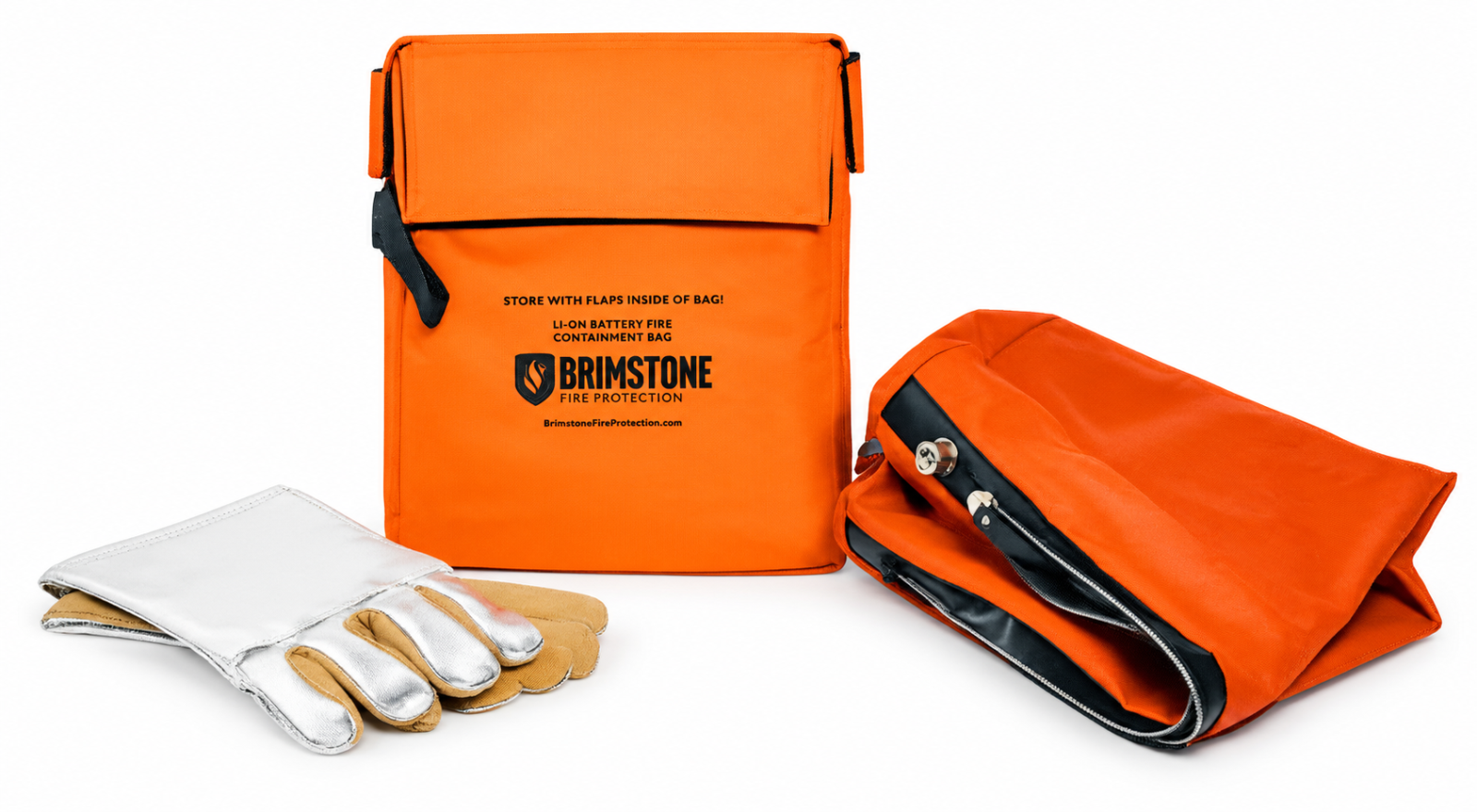
Fire Containment Bag
The heavy-duty fire containment bag is designed to help mitigate the consequences of a lithium-ion battery fire. Depending on the model, the manufacturer states that the bag has been tested in thermal runaway scenarios involving batteries rated at up to 90 Wh, 100 Wh or 160 Wh.
02 / Smoke Containment
Smoke Containment Bag
The outer bag is designed to help limit the escape of smoke and combustion by-products into the surrounding environment. It incorporates a pressure-relief valve to help regulate pressure inside the bag.
When using a complete set, the affected device is first placed inside the fire containment bag. The closed fire containment bag is then placed inside the smoke containment bag, following the manufacturer's instructions.
Important: These products are not a substitute for prescribed emergency procedures, crew training or the manufacturer's instructions. Their use must always be consistent with the circumstances of the incident and the applicable operating procedures.
Available at Pilotshop.cz
Which Brimstone Preventer™ Set Should You Choose?
Choose the appropriate solution based on the device dimensions, battery capacity and equipment required.
For Larger Devices
X-Large HD Preventer™ Plus Li-Ion – S160 Set
For larger laptops and selected medical devices
This set is intended for devices with a battery capacity of up to 160 Wh. It is particularly suitable for operators who require a solution for larger portable electronic devices, such as laptops or selected AED units.
The set includes:
- X-Large Heavy Duty Li-Ion Fire Containment Bag;
- S160 Smoke Containment Bag;
- One pair of heat-resistant protective gloves;
- Identification label;
- Emergency-use instruction card.
The S160 bag offers more internal space than the S100 model. Its foldable design also allows the set to be stored compactly when not in use. The manufacturer states that the fire containment bag has been tested in thermal runaway scenarios involving batteries rated at up to 160 Wh.
View X-Large HD S160 Set →
For Laptops
Large HD Preventer™ Plus Li-Ion – S100 Set
For laptops and devices with batteries rated up to 100 Wh
The Large HD model combines a Large Heavy Duty fire containment bag with an outer S100 smoke containment bag. It is intended for compatible laptops and other electronic devices with a battery capacity of up to 100 Wh.
The set includes:
- Large Heavy Duty Li-Ion Fire Containment Bag;
- S100 Smoke Containment Bag;
- One pair of heat-resistant protective gloves.
This configuration is a practical option for operators seeking a combined fire and smoke containment solution for standard laptops and other compatible electronic devices. The manufacturer states that the fire containment bag has been tested in thermal runaway scenarios involving batteries rated at up to 100 Wh.
View Large HD S100 Set →
Compact Solution
Small HD Preventer™ Plus Li-Ion – S100 Set
For mobile phones, tablets and smaller electronic devices
The smaller Small HD version is designed for compact electronic devices, particularly mobile phones and tablets. The set combines a compact fire containment bag with an S100 smoke containment bag.
The set includes:
- Small Heavy Duty Li-Ion Fire Containment Bag;
- S100 Smoke Containment Bag;
- One pair of heat-resistant protective gloves;
- Identification label and instruction card.
The manufacturer states that the fire containment bag has been tested in standalone use in thermal runaway scenarios involving batteries rated at up to 90 Wh. Before use, always verify the battery's actual capacity and confirm that the device is suitable for the selected model.
View Small HD S100 Set →
Standalone Bag
S100 Preventer™ Plus Smoke Containment Bag
Standalone smoke containment bag
The S100 bag is designed to be used with a compatible Brimstone Preventer™ Li-Ion fire containment bag, which is sold separately.
Its purpose is to help limit the escape of smoke and combustion by-products during an incident involving a lithium-ion battery. The design incorporates a pressure-relief valve and a flexible construction that makes storage easier.
The manufacturer states that representative materials used in the product meet the requirements of FAA 14 CFR Part 25, Appendix F. This statement concerns the relevant material requirements and should not be interpreted as certification of the complete product to UL 5800.
The standalone S100 bag is not a replacement for a fire containment bag. Before selecting it, verify compatibility with the specific Fire Containment Bag model being used.
View S100 Smoke Containment Bag →
How to Choose the Right Solution
When selecting a product, consider the dimensions of the device, battery capacity, compatibility of the individual components and the requirements of your operation. Always consult the technical documentation for the specific product and follow the applicable emergency procedures.